

Many Dubai businesses consider their branding done the moment a logo file arrives in their inbox. In reality, they have only reached the starting line — and the way the logo was commissioned often decides whether the rest of the brand holds together or falls apart.
One of the most persistent and costly mistakes in graphic design is treating a logo as a finished asset rather than the entry point to a wider system. A logo delivered without guidelines, colour codes, typography, an Arabic version or production-ready files leaves every future designer, printer and developer to guess.
The effects show up across Dubai’s market: a logo that looks different on Instagram, signage, stationery and the website, recognition that never builds, and trust that quietly erodes.
This article focuses on the commissioning stage. It covers the five mistakes businesses most often make when they brief and buy a logo, why each one causes problems later, and a simple briefing process that avoids them. If you are about to hire a designer, read this before you send the brief.
Why the Way You Commission a Logo Matters
A logo is a single mark. On its own it cannot tell your social media manager, printer or web developer which colours, typefaces or layouts to use. Each person fills the gaps differently, and inconsistency builds quietly across every channel.
Even a well-designed mark degrades under those conditions. Teams improvise, fonts drift and colour values shift between print and screen. The logo you paid for becomes a loose reference that different people apply in different ways.
Almost all of this can be prevented at the briefing stage. The decisions you make before a designer starts — what you ask for, in which languages, in which formats and with which rights — shape what you receive.
Mistake 1: Briefing for a Logo as the Final Deliverable
Many logo-only briefs end with a folder of PNG and PDF files: no colour codes, no defined typefaces, no usage rules and no guidance on what comes next.
The consequences arrive quickly. When the social media manager, printer and web developer each interpret the brand on their own, one uses the wrong shade of blue, another substitutes a default font and a third stretches the mark to fit a banner. None of them is wrong; they simply have nothing to follow.
Recognition comes from repeated exposure to a consistent visual system, not from a single mark. Stopping at the logo removes the mechanism that makes recognition possible.
The fix is a change of framing, not a bigger budget. Treat the logo as one output of a short strategy and discovery phase. Positioning should come before the logo brief, and the logo should grow out of it rather than replace it.
Mistake 2: Accepting a Logo Sheet Instead of Usage Guidelines
A PDF showing your logo on a white and a dark background is a presentation slide, not a set of guidelines.
Working guidelines tell every supplier how to use the brand. At minimum they should give exact colour values (HEX, RGB, CMYK and, if you print a lot, Pantone), named typefaces with a simple hierarchy, clear-space and minimum-size rules, and examples of correct and incorrect use. Without exact colour values, a printer will match your colour from a screen preview and a developer will pick a system font, and each new asset will drift further from the last.
In Dubai, where a brand typically appears across many touchpoints in both Arabic and English — signage, digital ads, social media and print — this level of guidance is a basic requirement.
The fix: list a guidelines document as a required deliverable in your brief. If you operate in Arabic and English, state clearly that the guidelines must cover bilingual use, not just the English version with an Arabic logo added.
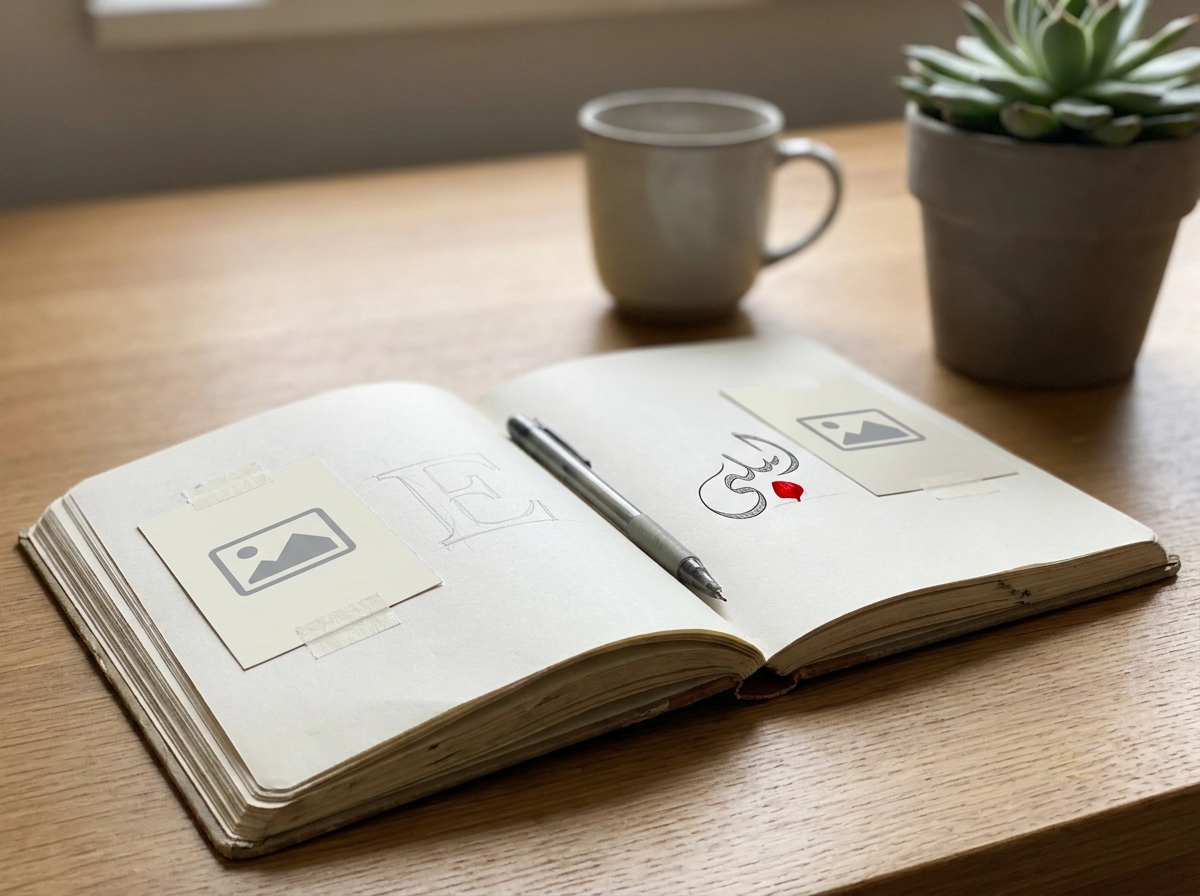
Mistake 3: Leaving the Arabic Version Until Later
Even businesses that ask for guidelines often scope the Arabic logo as a follow-up task rather than part of the original brief.
The usual sequence is an English logo first and an Arabic version afterwards, treated as translation. That order is the problem. Arabic and Latin type differ in visual weight, proportion and spatial logic. A well-balanced English lockup, translated directly, rarely looks equally balanced in Arabic: the letterforms connect differently, the script runs right to left and stroke weights that feel right in Latin can look heavy or thin in Arabic at the same size.
Bilingual logos work best when both scripts are designed together, sharing proportions and receiving equal attention on a sign, app screen or pack. Research on bi-scriptual Arabic-Latin typography supports this: when one script gets less design attention than the other, readers of that language notice and feel sidelined.
The fix: brief Arabic and English as parallel workstreams from day one, with equal design time, rather than as two sequential steps.
Mistake 4: Not Specifying Production-Ready File Formats
File formats are a separate issue from language, but they carry a similar cost.
A logo supplied only as a low-resolution PNG or flattened PDF is not ready for production. It cannot be enlarged for a hoarding, embroidered on uniforms or reproduced on signage without breaking up. Many businesses only discover this when a printer or signage supplier rejects their files.
Ask for these in the brief:
- Vector source files (AI, EPS or SVG) that scale without losing quality
- Print-ready CMYK PDFs for physical production
- Web-optimised transparent PNGs in several sizes
- Dark and light versions of the mark, plus a single-colour version
The fix: list the required formats in your brief before work begins, so production-ready delivery is part of the agreed scope rather than an extra.
Mistake 5: Not Confirming Ownership of Source Files and Rights
The final mistake is contractual. Exported PNGs and PDFs are outputs; editable source files are the real asset. If the agreement does not say that source files and usage rights transfer to you, every future change may mean going back to the original designer — or starting again.
This matters more than it seems. Rebrands, new sub-brands, signage updates and website redesigns all depend on access to the original artwork. Businesses that cannot find or do not own their source files often end up paying to recreate a logo they already bought.
The fix: confirm in writing, before you sign, that all final source files and the rights to use, adapt and reproduce the logo transfer to your business on completion. Also clarify whether any fonts used need a commercial licence.
What to Ask For Instead
Avoiding these five mistakes usually means commissioning more than a logo on its own: at least a logo suite, a colour system, a typography system, usage guidelines and production-ready files, with Arabic built in where you need it.
For the full list of what a complete identity project should include, and how to judge whether a quote covers it, see this guide to what a brand identity design service should include. Use it as a checklist against any proposal before you sign.
Getting this right matters because inconsistency is expensive. When every new asset is built from interpretation rather than instruction, it erodes the recognition and trust the logo was supposed to build. Internally, teams waste time hunting for the right file, guessing colours and fixing mistakes until someone commissions an audit and the rework begins.
A Simple Briefing Process for Commissioning a Logo
Follow these steps before you approach any designer.
1. Map every place the logo will appear. List your website, social channels, printed materials, packaging, signage, presentations, uniforms and any language versions. This list is the foundation of your brief.
2. Turn that list into required deliverables. Each place needs specific files or variants. When proposals arrive, check them line by line against your list. If something is not in the proposal, assume it will not be delivered.
3. Ask each designer for a sample of their guidelines. One look tells you whether they produce working guidance with exact values and rules, or a decorative presentation.
4. Brief Arabic and English together. If you need both, give each its own line item and timeline in the brief.
5. State file formats and ownership in writing. List the formats you need and confirm that source files and rights transfer to you on completion.
6. Choose someone who understands how the logo will be used. A logo has to work across websites, social media and ads as well as print. A designer who understands digital channels will plan for those uses from the start.
Conclusion
A logo is a starting point, not a finished brand. Most of the problems businesses run into later — inconsistent touchpoints, missing Arabic versions, unusable files and lost source artwork — trace back to how the logo was commissioned.
The fix is in the brief. Ask for guidelines alongside the mark, design Arabic and English together, specify production-ready formats and secure ownership of the source files. Do that, and your logo can be applied consistently everywhere it appears.
If you already have a logo that was delivered without these elements, start with a quick audit: list what you have, compare it with the checklist above and close the gaps before inconsistency spreads further.
Design & branding packages
Need design that looks professional everywhere?
Fixed-price logo, brand identity and design packages from AED 1,800, with a reply within 1 business day. Not sure what you need? Message me on WhatsApp for a free 10-minute review of your current brand.
